
Specification Is Not the Same as Value. Most Developers Are Spending as Though It Is.
When margins compress, the instinct is almost universal:
Upgrade the specification. Swap the composite worktops for stone. Upgrade the flooring. Improve the sanitaryware.
The logic is intuitive: a more expensive finish must support a higher price. In practice, it frequently does not. And the gap between what that spend costs and what it recovers is one of the more persistent sources of margin erosion in the boutique residential market.
The Specification Trap
The assumption that specification drives valuation is understandable. It is also, in most cases, only partially true. Premium finishes contribute to perceived quality, and perceived quality matters. But they operate on top of something more fundamental: the spatial experience of the unit. And when the spatial experience is weak, better finishes do not resolve it. They make a poorly performing product more expensive to deliver.
Savills' residential research has consistently noted that buyer willingness to pay at the upper end of a local price range is driven primarily by how a property feels in person, not by the specification schedule. A unit that feels generous, logical, and well-considered commands more than one that is materially superior but spatially confused. That distinction is not aesthetic. It is financial.
The 55-Square-Metre Problem
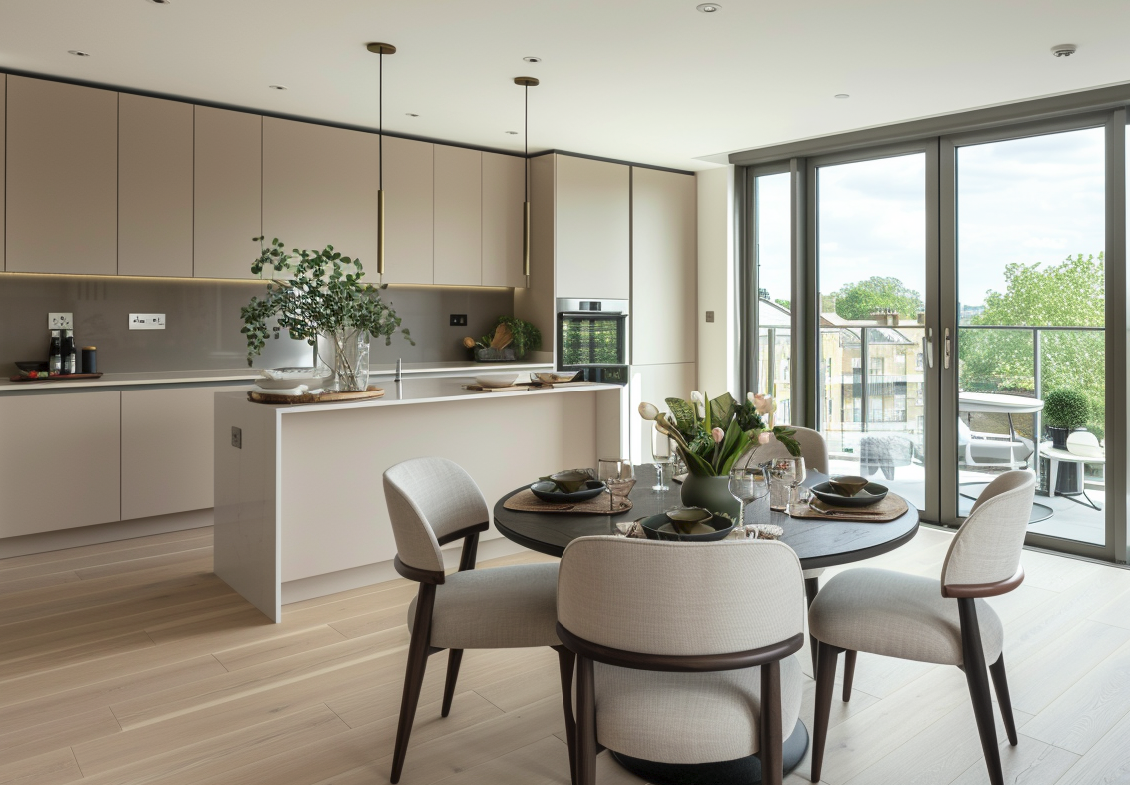
A well-planned 55-square-metre flat can feel materially larger than a poorly organised 65-square-metre unit. Not because of any illusion, but because of sightlines, circulation, the placement of glazing, and the absence of space that serves no purpose.
When a buyer or valuer walks in, they are not measuring the floor. They are experiencing the room. And that experience, formed within the first few seconds, shapes the number they are prepared to attach to it.
Knight Frank's prime residential data has pointed to this pattern repeatedly: perceived spatial quality is a stronger predictor of transactional confidence than specification grade. Buyers negotiate harder on properties where the layout creates uncertainty, regardless of finish quality. Properties where the spatial logic is clear, and the layout reads as considered rather than constructed, attract fewer price challenges and faster decisions.
Where the Value Is Actually Created
The commercial case for spatial quality over specification investment is not theoretical.
It is measurable at the point of valuation. A scheme where layout efficiency has been rigorously worked through, where room proportions support the furniture arrangements a buyer expects, and where the arrival sequence creates an immediate sense of quality, will consistently support a higher per-square-foot value than a scheme of greater specification but lesser spatial clarity.
This matters most in the boutique development market, where the margin between an average and an exceptional exit is often determined not by the total cost of the build, but by the decisions made before a single wall was drawn. The specification can be adjusted late in the process. The layout cannot. Once planning is approved and the structural frame is set, the spatial logic is fixed. What is left is the surface. And surface, however well chosen, cannot correct a floor plan.
The Sequencing Question
The practical implication is a sequencing issue.
Most development processes treat spatial decisions as the architect's domain and commercial decisions as the developer's. The two run in parallel, occasionally intersecting, but rarely integrated. The result is that layouts are optimised for planning compliance and construction efficiency, while commercial performance, how the unit will be experienced, priced, and sold, is considered afterwards.
Property Week has shown this pattern across the build-to-sell market: the schemes that consistently outperform on price per square foot are those where spatial performance was treated as a commercial priority from the outset, not a design consideration resolved after the harder decisions were made. That shift in sequencing does not require a larger budget. It requires the right questions at the right stage.
What This Means for the Current Market
In an industry where construction costs remain elevated and buyer caution has not fully unwound, the schemes that will sustain margin are not those with the most impressive specification schedules. They are those where the underlying spatial product is strong enough to command the asking price without relying on finish quality to carry the argument.
That standard is achievable at any specification level. It does not require a premium budget. It requires that spatial decisions, layout, proportion, circulation, sightlines, are made with commercial intent rather than structural convenience. The profit in a scheme is not created at practical completion. It is either secured or surrendered at the design stage, before the specification conversation has even begun.
Raquel Aparicio is the founder of Mar Design, where she advises residential developers and boutique hospitality operators on market-aligned design strategy to improve GDV, ADR, pricing confidence, and long-term asset performance.