
Layout Is a Financial Decision. Most Developers Are Not Treating It as One.
Ask a developer what drives GDV and most will give the same answer: location, specification, and market conditions. Those three factors are real. But there is a fourth that receives far less attention, and which has a more direct relationship to price per square foot than any of them. Layout. The way space is organised inside a unit determines how a buyer experiences it, how it photographs, how an agent describes it, and, most directly, whether a buyer will pay the asking price or negotiate below it.
Why Layout Is Treated as an Architectural Problem
The conventional development process positions layout decisions within the architect's scope. The architect designs for planning compliance, structural logic, and space efficiency. These are legitimate priorities. They are not the same as commercial priorities. A layout optimised for planning will not always be one optimised for buyer perception. A floorplan that efficiently uses every square metre will not always feel generous, functional, and worth the asking price to the person standing in the empty shell deciding whether to exchange.
When layout decisions are made without input from a commercially informed design perspective, one shaped by how buyers actually respond to space, the result is often technically sound but commercially underperforming.
The Specific Ways Layout Erodes Value
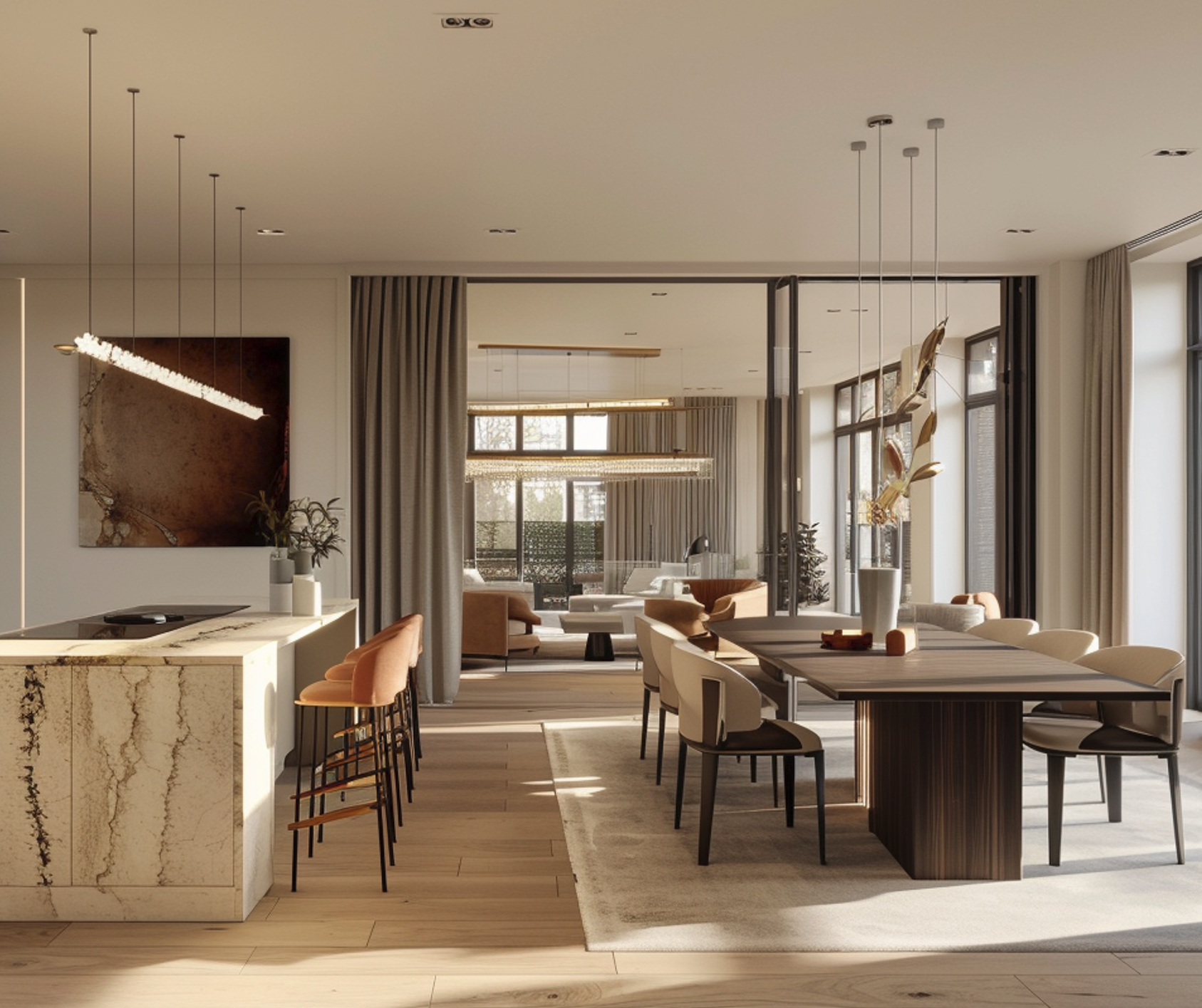
The mechanisms are consistent across project types and price points. Entrance sequences that fail to create a sense of arrival. Living spaces where the natural furniture arrangement is immediately obvious and immediately uninspiring. Kitchens positioned as functional afterthoughts rather than focal points. Bedrooms where door and window placement creates dead zones that resist any practical use. Bathrooms that are compliant but communicate cost-minimisation rather than quality.
Each of these is a layout decision. Each creates a moment in a viewing where a buyer's confidence in the price reduces, often without them being able to articulate why. Knight Frank's prime residential research has noted that perceived spatial quality, rather than actual square footage, is among the most influential drivers of buyer willingness to transact at the asking price. The distinction matters: it is not about how much space there is, but about whether the space works.
The Relationship Between Layout and Specification
One of the more costly assumptions in development is that specification upgrades can compensate for layout weaknesses, that premium appliances or distinctive tiling can offset an unresolved floorplan. It does not work that way. Specification operates on top of the spatial experience. If that experience is poor, the specification makes a weak product more expensive. It does not make it more desirable.
Developers who redirect specification budget toward improving spatial logic, adjusting room proportions, refining circulation, and clarifying the relationship between kitchen and living space, consistently see stronger returns than those who spend the same money on finishes applied to an unresolved plan. Savills' residential valuation commentary repeatedly identifies layout efficiency and room quality as the factors that sustain value at appraisal, particularly as lender scrutiny of new-build comparables has tightened.
What Changes When Layout Is Treated as a Commercial Decision
When layout is evaluated through a commercial lens, asking not just whether this works spatially but whether it justifies the price, several things shift. Apartment mix decisions become more considered. Specification investment is concentrated where buyer perception is highest: the arrival sequence, the kitchen as a social anchor, the master bathroom. Marketing conversations become easier. When a unit has a clear spatial logic and reads well both physically and in two dimensions, agents can price it with confidence.
Property Week's coverage of new-build sales performance in competitive urban markets points to a consistent pattern: schemes with strong spatial clarity achieve asking price more frequently, require fewer incentives to close, and generate stronger comparable evidence for subsequent phases. These are not design outcomes. They are financial ones.
The Entry Point
The best time to address layout is before planning submission. At that stage, fundamental decisions can still be made: room proportions adjusted, circulation refined, the relationship between units reconsidered. After planning is approved, the options narrow. Post-build, they are largely gone. In a market where margin is under pressure from every direction, the layout review is not a design exercise. It is a financial one, and the returns on getting it right are among the most direct available at that stage of the process.
Raquel Aparicio is the founder of Mar Design, where she advises residential developers and boutique hospitality operators on market-aligned design strategy to improve GDV, ADR, pricing confidence, and long-term asset performance.